Pair rule genes
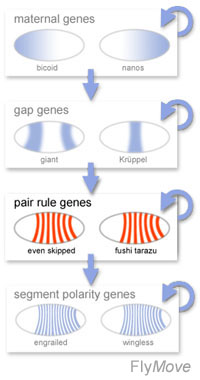 The
discovery of the pair rule genes was rather unexpected. In mutants of
the pair rule genes, every other segment is lost, indicating that the
process of segmentation proceeds through an intermediate phase in which
segments are organized in a double periodicity. Accordingly, pair rule
genes are expressed in a pattern of 7 stripes, half of the number of segments
in a wild-type larva.
The
discovery of the pair rule genes was rather unexpected. In mutants of
the pair rule genes, every other segment is lost, indicating that the
process of segmentation proceeds through an intermediate phase in which
segments are organized in a double periodicity. Accordingly, pair rule
genes are expressed in a pattern of 7 stripes, half of the number of segments
in a wild-type larva. Two different classes of pair rule genes are distinguished. The primary pair rule genes translate spatial information provided by the maternal and gap genes into a striped pattern. Stripes are regulated independently by a characteristic combination of gap genes. Secondary pair rule genes, like fushi tarazu, are regulated by the primary pair rule genes, with each stripe executing the same response. The expression of pair rule genes is very dynamic; expression patterns can change considerably over time. These changes are driven by interactions between all, primary and secondary pair rule genes.

Pair rule genes
|
Gene
|
Type -
Domains
|
Function
|
Links
|
|
even-skipped (eve)
|
transcription factor - homeodomain
|
pair rule gene establishing epidermal cell fate
|
|
|
fushi tarazu (ftz)
|
transcription factor - homeodomain - Antp class
|
pair rule gene
|
|
|
hairy (h)
|
transcription factor - bHLH - Hairy/E(spl) class
|
pair-rule gene, later it antagonizes sensory bristle
formation
|
|
|
odd paired (opa)
|
transcription factor - zinc finger
|
pair rule gene activates engrailed and wingless during
segmentation
|
|
| odd skipped (odd) | transcription factor - zinc finger | pair rule gene - mutants associated with cuticle defects that are limited to alternate--odd-numbered--segments | Interactive Fly |
|
paired (prd)
|
transcription factor - homeodomain, paired domain
|
pair rule gene, required for the progression from pair-rule
directed segmentation to specifying positional information within
segments (segment polarity genes)
|
|
|
runt (run)
|
transcription factor - novel
|
pair rule gene, also contributes to neuroblast cell
identity
|
|
|
sloppy-paired (slp)
|
transcription factor - forkhead domain
|
has combined characteristics of a gap, pair rule and
segment polarity gene
|
|
| Tenascin major (Ten-m) | transmembrane - tenasin homolog - EGF and Fibronectin repeats | pair-rule gene product | Interactive Fly |